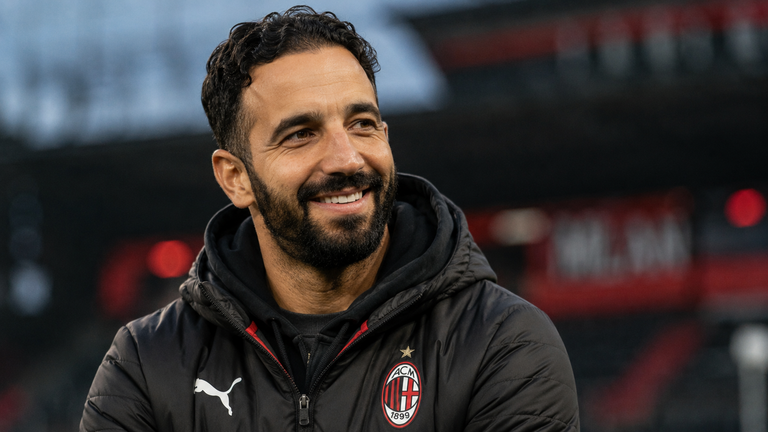
Ruben Amorim's Milan opened the Serie A season with a win at Torino, and the performance offered the clearest look yet at how different this team will be from the one Massimiliano Allegri left behind just weeks ago.
The scepticism is understandable, and earned. Milan have reached for the phrase "new era" too often lately, from the optimism around Paulo Fonseca after Stefano Pioli's decline to the safe-hands pairing of Allegri and Igli Tare, who knew the league and the club and still oversaw a late-season collapse. Amorim arrives fresh off a difficult spell at Manchester United, surrounded by inexperienced management and an owner in Gerry Cardinale who has chosen to be more hands-on than ever. Asking why this time should be different is a fair question.
What has changed first is the method. From Amorim's opening days at Milanello in early July, the working style broke sharply from his predecessor. Allegri was famously hands-off, delegating training to his staff while he oversaw, an approach his trophy cabinet justified. Amorim instead throws himself into rondos, drops to his knees screaming when a drill comes off, and the players have been filmed laughing through it. None of that wins matches, but a squad watching a coach care that visibly is a squad with something to feed off.
Preseason gave little to cling to at first. Milan went two goals down to Celtic before drawing, needed a late penalty to salvage a 1-1 with Inter, and were beaten 3-0 by Chelsea. The turn came against Manchester United in Poland, a friendly that carried a personal edge for Amorim given how his Old Trafford tenure ended. Milan won 4-2 playing quick, front-foot football, with Alphadjo Cisse, Samuel Chukwueze, Gonçalo Ramos and Ruben Loftus-Cheek all involved, and the intensity was more than their Premier League opponents could handle.
The Torino selection then raised eyebrows, with Pervis Estupiñán, Yunus Musah and Loftus-Cheek all named in the XI. The football itself answered the doubts. Twelve seconds in, four Milan players pressed Torino back into their own box, a snapshot of everything Amorim has preached: high press, high line, high tempo. After half an hour Milan had 78% of the ball and finished on 59%, well up on last season's 52% average. They managed 10 shots from inside the box in the first half alone, something Allegri's low-event side never did once across 46 Serie A matches last term.
The contrast runs deeper than numbers. Amorim fielded the highest average defensive line of any side in the division over the weekend and spoke on day one of "possession-based domination." Allegri wanted to defend deep, minimise errors and let opponents have the ball. Amorim wants his players bold, accepting the risk that comes with it. The individual choices tell the same story: Musah and Chukwueze were quickly written off a year ago, yet Amorim looked at them in preseason and decided he could use them, while Cisse got the nod on the left and marked it with a goal.
The final 15 to 20 minutes were a warning. Milan sat under sustained Torino pressure, particularly after summer signing Mario Gila, one of the night's positives, was withdrawn, and Che Adams pulled a goal back with a strike that left the result open until the last kick. Cardinale watched all of it from pitchside, the stands and then the dressing room, and saw both the ceiling and the floor of this side inside 90 minutes. The high line and pressing produce dominant spells; the same approach also invites chaos when momentum turns, and it will turn more often without sufficient depth. If the owner was weighing whether to free up money for another piece or two, Turin gave him the case for both sides.
Cardinale set the tone before the season with a line that will be tested all year: "We will play to win, not to avoid losing." Last season Milan won 12 of their first 18 and topped the table at points, a machine under Allegri right up until it jammed.
This is a more entertaining Milan and a more chaotic one, and the bumps are a certainty rather than a risk; whether the trade is worth it is Amorim's to prove over the coming months.