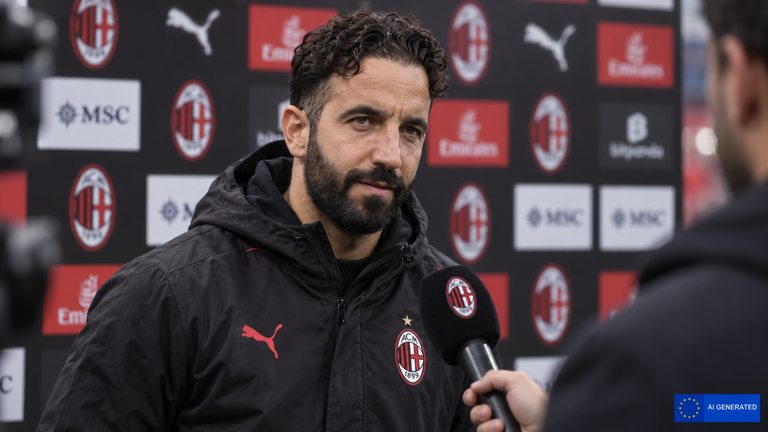
Ruben Amorim acknowledged mounting frustrations with Milan's approach after Benfica delivered a comfortable Europa League victory at San Siro on Wednesday night, leaving more than 65,000 home fans with little to celebrate.
The defeat extended a worrying pattern: for the second consecutive match, Milan failed to compete in the opening 45 minutes, and Amorim's post-match comments suggested he is still searching for answers to problems that are becoming entrenched rather than isolated.
"Sometimes we create more problems for ourselves when we have the ball than when the opponent has it," Amorim told Sky, as relayed by MilanNews. "We're trying to create automatic movements, but we don't create. We keep the ball, but we lack creativity near the penalty area."
The first-half collapse followed a familiar script. Once Benfica scored, Milan's composure evaporated. "When we conceded in the first half, we completely lost what we were supposed to do," Amorim said. "We wanted to do everything quickly, but we lacked quality. We lose the ball in certain moments that are really dangerous."
Asked directly whether the defensive structure needs more attention, Amorim pointed to a broader problem. "Everything is connected. We're not very organised. For the first goal, when the player carries the ball, we're already too deep. When we lose the ball, we're all too close together and too deep. We need to improve our defence, we need to score first and take the game to a different level. We're not creating many opportunities."
A lack of movement behind the opposing backline was another theme. Amorim admitted that in the first half, nobody was attacking the space behind Benfica's defence, which in turn starved the attacking midfielders of room to operate. The instruction was repeated at the interval, but the second half brought only marginal improvement, with Benfica content to sit on the edge of their box and wait.
Amorim also addressed why he did not start the players who transformed the second half in Rome. The reasoning was physical rather than tactical. Adrien Rabiot had played a full 90 minutes and there were doubts over his capacity for another extended outing. Christian Pulisic had managed only 45 minutes last time out, and his injury history demanded caution. Alberto Moreira, meanwhile, missed two days of training due to a personal issue. "It's not a matter of a couple of players; we have to be a better team," Amorim said.
He did offer one concrete example of where Milan came close to creating something. "We get close to the box a lot, but no one attacks it, even when Chukwueze crosses. Before the second goal, we had a chance with De Winter, who was free. We have to be a better team."
Pressed on whether he would consider moving away from his 3-4-2-1 system, Amorim stopped short of announcing a formation change but left the door open. "I'm constantly changing. We've done two months of work, and we'll definitely find ways to adapt. We need to develop a way of doing things, but we also need to win games. I'm ready to adapt."
Two months into the job, the patterns Amorim wants are not appearing on the pitch, and the patterns he does not want are repeating. Whether adaptation means tweaking the system or overhauling it, that decision now sits with him, and the next fixture will tell the supporters which direction he has chosen.