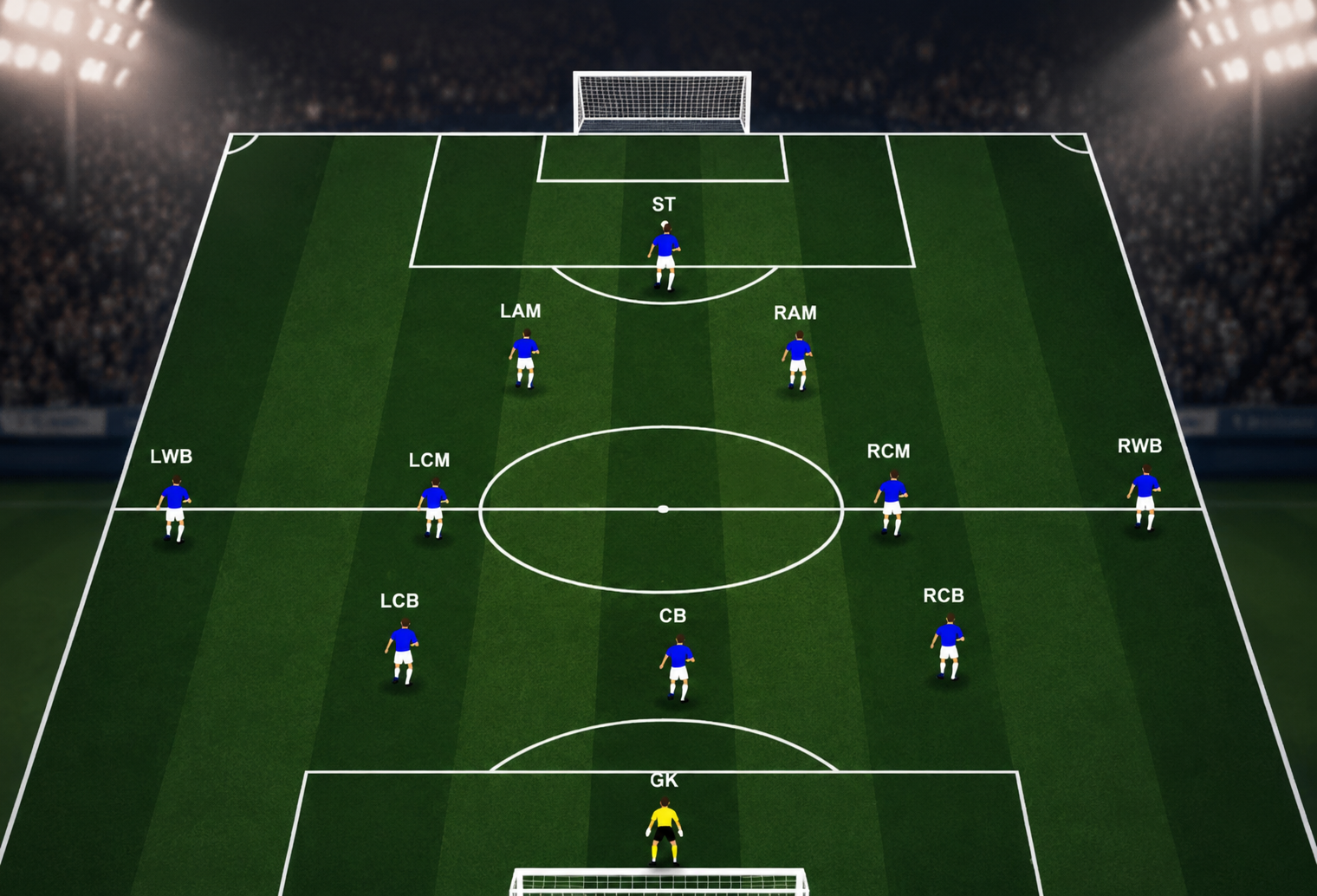
Ruben Amorim's move to a 3-4-2-1 reshapes how four key players will be used, with Luka Modric, Alexis Saelemaekers, Christian Pulisic and Christopher Nkunku all facing new roles.
According to La Gazzetta dello Sport, the project launched by Amorim and Gerry Cardinale rests on what looks like a small adjustment, the switch from a 3-5-2 to a 3-4-2-1, but one carrying plenty of tactical detail underneath. The consequence is that several familiar players have to think differently about where they stand and what they do.
Modric is the first case. A midfielder of his quality can operate in almost any setup, but a two-man midfield asks different things of him than the three-man units he has grown used to. At Real Madrid he spent years as a right-sided midfielder in a trio, alongside Casemiro in front of the defence and Toni Kroos as the left mezzala.
That changed once Casemiro left. In his final season under Carlo Ancelotti, Modric was mostly deployed in a 4-2-3-1, either at the tip of the attacking midfield or, more often, in a double pivot with Tchouaméni, Camavinga or Valverde. Croatia use him in a two-man midfield as well, so the shape itself is nothing new to him.
The catch is coverage. In a midfield three, the central players screen the centre-backs; in a two, the ground to protect grows, and Gazzetta stresses that the balance depends heavily on the wing-backs doing their job. Without it, the structure comes apart.
One of those wing-backs will be Saelemaekers, though the side is not yet settled. Amorim likes players operating with inverted feet, which points to the Belgian on the left. His core brief stays the same, winning his one-on-ones and covering the whole flank in both phases, but he now has to build an understanding with attacking midfielders who were not part of last season's setup. Switching flanks means adapting to a different angle and plan, although his loans at Bologna and Roma already gave him time on the left.
The inverted-feet idea also shapes Pulisic's role, with Amorim set to use the American on the left flank. After years as a winger and as a second striker, the change is meant to push him into the space between the lines and the half-spaces.
Nkunku completes the group. He has played as a winger, striker, second striker and attacking midfielder across his career, and Milan will now try to draw out the form that made his name at RB Leipzig.
For all four, the shift is less about learning a new position from scratch and more about whether the wing-backs give Amorim's system the balance it needs to hold together.