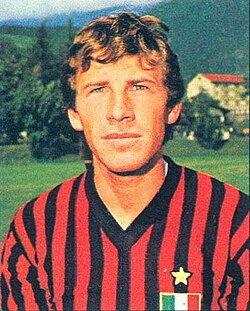
Franco Baresi died yesterday at the age of 66, and the story of his rise from a rejected youngster to one of the greatest defenders the game has known stands as a lesson in character for the footballers who came after him.
Today's edition of Gazzetta dello Sport has given several pages to the Milan legend, tracing a career defined as much by the setbacks he overcame as by the trophies he lifted. He had fought illness in recent years before losing his final battle.
The beginning carried an irony that shaped his whole life. In 1974, on the recommendation of Oratory Sports Union of Travagliato director Guido Settembrino, Baresi joined Milan after Inter rejected him. His older brother Beppe, two years his senior, was taken on by the Nerazzurri's youth team instead. It was Italo Galbiati, struck by the boy's technique, whose instinct brought Franco to the Rossoneri.
With a blond bob and a delicate touch, his slight appearance deceived opponents until the first tackle changed their minds. The masseur Mariconti gave him the nickname Piscinin, 'little one' in Milanese dialect, and it stuck for life.
Nils Liedholm handed him his Serie A debut on 23 April 1978, a 2-1 Milan win, and rather than treating the youngster as a lucky charm, the Swedish coach built the following season around him. Gianni Rivera saw a champion in the young defender early, and the story goes that during a Città di Milano tournament match against Flamengo at San Siro, Baresi called out to the Golden Boy: "So, can you pass me?" Rivera applauded the courage. At just 22, Baresi was made Milan captain.
The setbacks came in waves. Relegation to Serie B after the Totonero scandal, a virus that sidelined him for three and a half months and put his future in doubt, and a second relegation in 1982. Through it all he kept rising, called up by Enzo Bearzot and part of Italy's 1982 World Cup triumph in Spain, though he never played a minute.
Courted by major clubs, Baresi chose to stay. His faith paid off when Silvio Berlusconi saved Milan from bankruptcy in 1986 and, a year later, brought in Arrigo Sacchi. Baresi became one of the finest interpreters of Sacchi's football, and with Gullit and Van Basten came the 1988 Scudetto, then the European Cup in 1989 with Rijkaard added, repeated in 1990. He lifted trophy after trophy without ever raising his voice; a look was enough for teammates to know their job.
When Fabio Capello replaced Sacchi, many wrote off Baresi and the old guard. Capello stung their pride, and the response was four more league titles and the 1994 European Cup. He had planned to retire from the Azzurri in 1992, but Sacchi, by then the national coach, talked him out of it, and Baresi led Italy to the 1994 World Cup final in America. He was the first to miss in the penalty shootout defeat to Brazil, and his tears on live television moved a nation.
Baresi retired in June 1997, his No.6 retired alongside him. He became club vice-president and took charge of the Primavera. His only spell away came in 2002, a stint as technical director at newly promoted Fulham that lasted under three months amid disagreements with Jean Tigana. He returned, and never left again.
Milan careers are measured in trophies, but Baresi's is measured in something the club could not replace, and the Rossoneri now carry it without him.